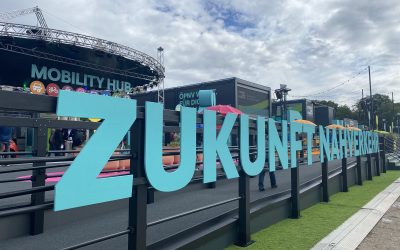
This year’s #SCCON2025 underscored that the digital transformation within the municipal sector has long been tangible. It is crucial to avoid thinking of technologies for public transport in isolation, but to interconnect them with each other. This integration is the key to achieving a successful local mobility transition.
Digital transformation as an opportunity for municipalities
Conversations with mobility managers and local authorities revealed that a successful mobility turnaround requires more than just new applications. The focus must also be on the intelligent integration of existing systems and the delivery of user-centric services across the board.
„Mobility as a Feature“ – the integrated approach for smart cities
Unlike Mobility as a Service (MaaS), which focuses on comprehensive platforms, Mobility as a Feature (MaaF) adopts a modular and flexible approach. Functional building blocks such as digital ticketing and on-demand transport are integrated directly into existing platforms – be it in citizen apps, employer portals or regional mobility solutions:
Advantages for municipalities:
- Users remain in their familiar digital environment.
- High-performance mobility services operate seamlessly and efficiently in the background.
- Municipalities retain full control over data, standards and designs.
Best Practise: Integration for Seamless Mobility Solutions
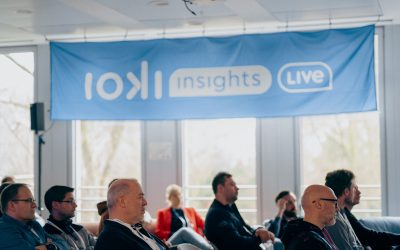
In our presentation, we used concrete application examples like in the city of Greifswald to show how ioki and Vesputi implement this approach in practice – and the benefits that arise for municipalities:
- Integration instead of isolated solutions: With the help of API-supported interfaces, ticketing and on-demand services can be efficiently integrated into existing systems.
- Tailor-made regional mobility: Flexible deployment options from employee shuttles to paratransit and event transports ensure sustainable utilisation.
- Seamless user experiences: Digital scalability enable municipalities to save resources and attract new target groups.
Mobility transition through technology and collaboration
SCCON 2025 has reiterated that sustainable mobility is achieved through collaboration, openness to technology, and a user-centric approach. We eagerly anticipate the opportunity to blend municipal needs with technological innovations in local transport, continually advancing the transport transition for our communities.
Re-watch the presentation by Maximilian Rütten (ioki) und Linus Frank (Vesputi) on #SCCON2025 in Berlin (German only): Mobility as a Feature: Bausteine für vernetzte Mobilitätslösungen in Ihrer Region