ioki | Website Systembild | Logo negativ

/ Reading: 3 min.

26. Mar 2020
/ Germany
Call-collecting taxi – A new approach to proven concepts
What began in 1977 in Friedrichshafen is today generally known as on-demand transport: In a large-scale experiment, the people of Friedrichshafen were the first in Europe to look for a solution to adapt the existing public transport system to meet demand - thus heralding the birth of the Rufbus.

But what was visionary and forward-looking in these days is still relevant today. For rural areas in particular, which are increasingly struggling with incomplete or uneconomical public transport services, flexible and need-based solutions can provide a remedy for lack of mobility.

But what’s behind the idea of the on-call bus, the call-collecting taxi and the call-line bus? And above all: what does digitisation have to do with all this?

Well, whereas in Friedrichshafen passengers still had to communicate their needs directly at the bus stop using a specially developed machine, the telephone or a postcard (and thus well in advance), today travel requests can be made easily and even at short notice using an app.

In the past, as well as today, different forms of operation are suitable depending on the area, demand and available resources. The combination of different modes, e.g. of timetable-free and timetable-linked transport systems, can be particularly efficient in showing new solutions and lead to more flexibility.

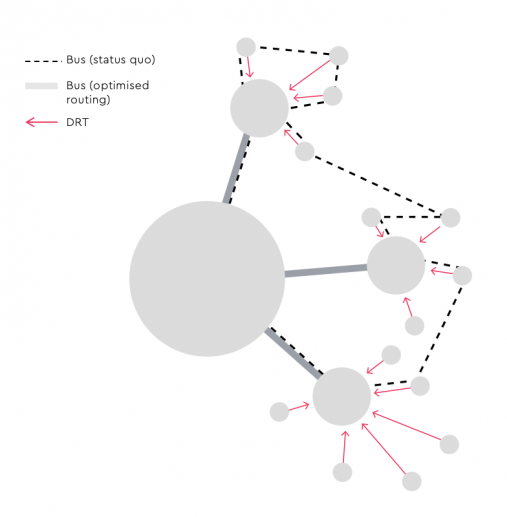
Smaller vessels such as on-call buses and on-demand shuttles, which serve as feeder services to regular public transport, are particularly suitable in sparsely populated regions. This eliminates inefficiencies such as detours, long journey times and empty runs for passengers and transport operators alike.

In interaction, this can take the following concrete form: Interchanges are still served by scheduled transport, while on-demand solutions as shuttle services facilitate access to these interchanges and, in addition, travel flexibly and freely within and between areas with lower demand.
Our experience, which we have gained not least in the digitisation of a shuttle bus in Wittlich, shows that passengers are quite prepared to pay a fair surcharge for the additional service and the newly gained comfort. When designing such services, however, it should be borne in mind that, although the booking is primarily digital, the target group often has less affinity for smartphones and the Internet connection is not always optimal.

By the way: If you think that in rural areas the acceptance of walking is far higher than in the city, you are mistaken. Here, too, citizens want mobility offers that do not require more than 200 to 300 metres of walking. All the more reason to strengthen the existing public transport system with flexible, cost-efficient and sustainable on-demand services.
Latest article

The Invisible Cost Factor: How Inefficient Driver Onboarding Slows Down Your Bus Company

The Invisible Cost Factor: How Inefficient Driver Onboarding Slows Down Your Bus Company

Today, bus companies are facing enormous challenges. The shortage of qualified drivers is an urgent issue that threatens the efficiency and safe operation of public transport. According to the Federal Association of German Bus Companies (BDO), there is already a shortage of around 20,000 bus drivers across Germany, and this number could rise to as many as 65,000 by 2030 if no countermeasures are taken. In Europe, the figure is even higher, with 105,000 unfilled positions for bus drivers, as evidenced by the IRU’s 2023 European Bus and Coach Driver Shortage Report. Over 80% of companies report significant or very significant difficulties in filling open positions. A central aspect that is often overlooked is the inefficient onboarding of new driving staff, which not only costs time and money but also increases turnover and poses potential safety risks.

Related articles

What is a Mobility Simulation?

What is a Mobility Simulation?

Mobility simulations are digital tools that show how people move around a city or region. In Germany, with its population of over 80 million people, traffic is so complex that we can never capture it completely. Mobility simulations help us build a comprehensive picture despite this challenge.

What is a railway station of the future?

What is a railway station of the future?

Railway stations of the future (known in German as ‘Zukunftsbahnhöfe’) are modern mobility hubs that go far beyond the classic function of a train station. Deutsche Bahn is developing stations across Germany into these innovative mobility hubs as part of its ‘Zukunftsbahnhof’ programme, focused on three key characteristics: customer-oriented for greater attractiveness, high-performing to accommodate more travellers, and sustainable in construction and operation. As part of this targeted modernisation programme, selected stations are being developed into attractive transport hubs according to uniform standards.