ioki | Website Systembild | Logo negativ

/ Reading: 3 min.

26. Oct 2023
/ Germany
Ridepooling in Transport Planning
Demand-responsive transport based on the ridepooling concept is on everyone's lips and has long been an important pillar of individual, public transport. Data-based transport planning is needed to realise the full potential of on-demand mobility. When transport companies want to start a new on-demand operation, they inevitably face the question of the right ridepooling design and the best balance between the costs and benefits of the flexible offer.
Ridepooling can increase the productive operating hours of on-demand operations. With ioki Analytics the Mobility Analytics and Consulting Team at ioki supports the planning and optimisation of new mobility offers with ridepooling. The operational and economic effects of different planning variations are determined in an operational simulation for different use cases. The basis for this is the traffic demand from the mobility simulation and the boundaries of the planned on-demand service area. In addition, we have data from existing on-demand services with the ridepooling software powered by ioki. The knowledge gained from these services also flows into the evaluation to analyse the demand in the best possible way. 

For the appropriate ridepooling use case and thus the success of the on-demand service, our experts take various parameters into account. These include fleet characteristics, the planned waiting and service times of the transport or how many detours are accepted for journey requests. Based on the ioki algorithm, the operational simulation can determine how many vehicles are needed to provide passengers with a high-quality service. In concrete terms, this means that the incoming ride requests are optimally distributed among the available vehicles.  

The ride pooling parameters diversions and waiting time have the greatest influence on the overall public transport system and on the passengers. As a rule, an increase in waiting time by a few minutes does not result in a loss of quality for passengers. After all, on-demand shuttles reach more people than scheduled public transport services. Our mobility experts work together with the transport companies to coordinate mobility concepts. 

More about Mobility Analytics at ioki here.
Latest article

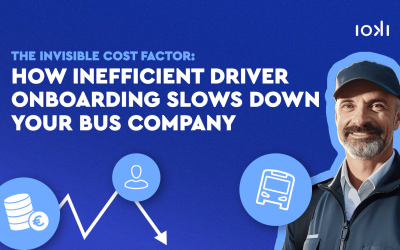
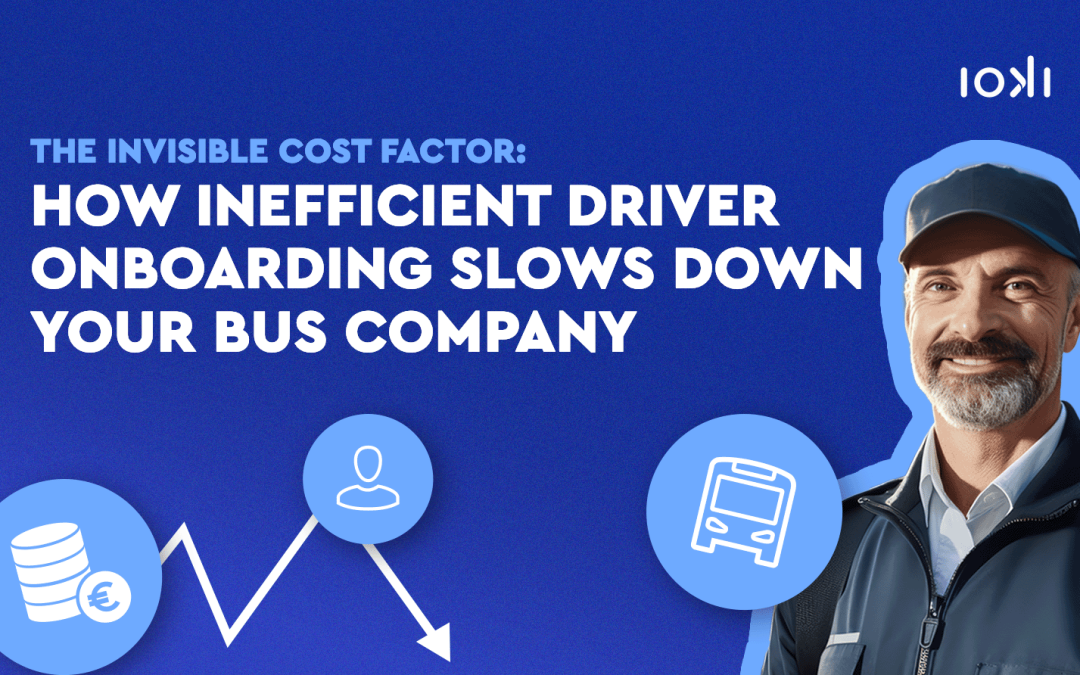
The Invisible Cost Factor: How Inefficient Driver Onboarding Slows Down Your Bus Company

The Invisible Cost Factor: How Inefficient Driver Onboarding Slows Down Your Bus Company

Today, bus companies are facing enormous challenges. The shortage of qualified drivers is an urgent issue that threatens the efficiency and safe operation of public transport. According to the Federal Association of German Bus Companies (BDO), there is already a shortage of around 20,000 bus drivers across Germany, and this number could rise to as many as 65,000 by 2030 if no countermeasures are taken. In Europe, the figure is even higher, with 105,000 unfilled positions for bus drivers, as evidenced by the IRU’s 2023 European Bus and Coach Driver Shortage Report. Over 80% of companies report significant or very significant difficulties in filling open positions. A central aspect that is often overlooked is the inefficient onboarding of new driving staff, which not only costs time and money but also increases turnover and poses potential safety risks.

Related articles

The Invisible Cost Factor: How Inefficient Driver Onboarding Slows Down Your Bus Company

The Invisible Cost Factor: How Inefficient Driver Onboarding Slows Down Your Bus Company

Today, bus companies are facing enormous challenges. The shortage of qualified drivers is an urgent issue that threatens the efficiency and safe operation of public transport. According to the Federal Association of German Bus Companies (BDO), there is already a shortage of around 20,000 bus drivers across Germany, and this number could rise to as many as 65,000 by 2030 if no countermeasures are taken. In Europe, the figure is even higher, with 105,000 unfilled positions for bus drivers, as evidenced by the IRU’s 2023 European Bus and Coach Driver Shortage Report. Over 80% of companies report significant or very significant difficulties in filling open positions. A central aspect that is often overlooked is the inefficient onboarding of new driving staff, which not only costs time and money but also increases turnover and poses potential safety risks.

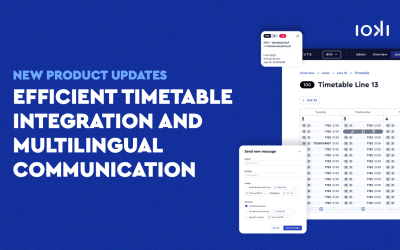
New Product Updates: Efficient Timetable Integration and Multilingual Communication

New Product Updates: Efficient Timetable Integration and Multilingual Communication

In the dynamic world of public transport, ioki is taking another step toward digital transformation: our new generation of software for ioki Route is improving communication and planning between drivers and control centres. With two key features—timetable integration and driver messaging—we are setting new standards for efficiency and collaboration in public transport.