ioki | Website Systembild | Logo negativ

/ Reading: 3 min.

16. Feb 2022
/ Germany
Mobility Data Regulation
Last September, the starting signal was given for the large-scale use of mobility data in transport planning. The Federal Council has agreed on the implementation of the German Mobility Data Regulation. The new regulation makes it possible to make German mobility data available on the so-called Mobility Data Marketplace. For companies from the mobility sector, the new regulation enables access to data sets which were not available before. Through the use of these data sets in the mobility sector, customers will benefit from new, data-driven mobility concepts that are precisely tailored to the actual mobility needs on site.

The challenge of data use
Multimodal mobility is the combined use of several forms of mobility such as public transport, on-demand shuttles, e-scooters, rental bicycles or other means of transport. For a useful cross-linking of these diverse mobility offers, the infrastructures must be combined in a suitable way in order to be able to create holistic mobility chains. Traffic data plays an important role in this combination. The data was not freely available before the introduction of the Mobility Data Marketplace.

The Mobility Data Regulation as a development booster
Through the introduction of the Mobility Data Regulation now things are changing. The Federal Ministry for Digital and Transport wants to stipulate the obligation of mobility providers to make data available based on the law on the modernisation of passenger transport to:

  • enable efficient, safe and sustainable public transport in the future
  • monitor compliance with the obligations under the Passenger Transport Act
  • and to specify the supply of multimodal travel information services.

Constant development
The extension of the Mobility Data Regulation is already planned by the BMDV. On the 1st of January, the category of static data was added in the Mobility Data Marketplace.  On July 1st, dynamic real-time data will follow. This spring, the current platform “Mobility Data Marketplace” will be replaced by the technically advanced, modern and user-friendly “Mobilithek” to simplify the exchange of data in real time. Third parties also have the opportunity to define and develop services to exploit the potential of the collected data from the Mobilithek. At ioki, our mobility analytics experts already use algorithms and data processing to analyse and optimise public transport infrastructures. Always with the primary goal of making mobility accessible for everyone. The Mobility Data Regulation is a good opportunity to strengthen public transport in the long term and to push forward the mobility turnaround.
Latest article

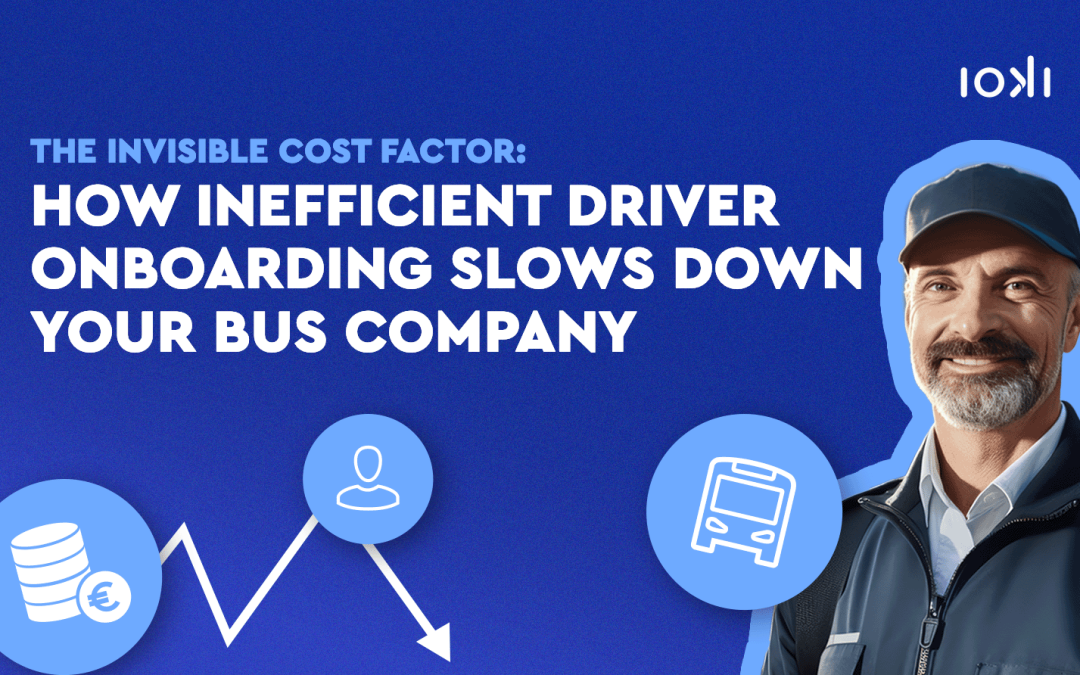
The Invisible Cost Factor: How Inefficient Driver Onboarding Slows Down Your Bus Company

The Invisible Cost Factor: How Inefficient Driver Onboarding Slows Down Your Bus Company

Today, bus companies are facing enormous challenges. The shortage of qualified drivers is an urgent issue that threatens the efficiency and safe operation of public transport. According to the Federal Association of German Bus Companies (BDO), there is already a shortage of around 20,000 bus drivers across Germany, and this number could rise to as many as 65,000 by 2030 if no countermeasures are taken. In Europe, the figure is even higher, with 105,000 unfilled positions for bus drivers, as evidenced by the IRU’s 2023 European Bus and Coach Driver Shortage Report. Over 80% of companies report significant or very significant difficulties in filling open positions. A central aspect that is often overlooked is the inefficient onboarding of new driving staff, which not only costs time and money but also increases turnover and poses potential safety risks.

Related articles

What is a Mobility Simulation?

What is a Mobility Simulation?

Mobility simulations are digital tools that show how people move around a city or region. In Germany, with its population of over 80 million people, traffic is so complex that we can never capture it completely. Mobility simulations help us build a comprehensive picture despite this challenge.

What is a railway station of the future?

What is a railway station of the future?

Railway stations of the future (known in German as ‘Zukunftsbahnhöfe’) are modern mobility hubs that go far beyond the classic function of a train station. Deutsche Bahn is developing stations across Germany into these innovative mobility hubs as part of its ‘Zukunftsbahnhof’ programme, focused on three key characteristics: customer-oriented for greater attractiveness, high-performing to accommodate more travellers, and sustainable in construction and operation. As part of this targeted modernisation programme, selected stations are being developed into attractive transport hubs according to uniform standards.